
This post contains affiliate links. As an Amazon Associate we earn from qualifying purchases, at no extra cost to you.
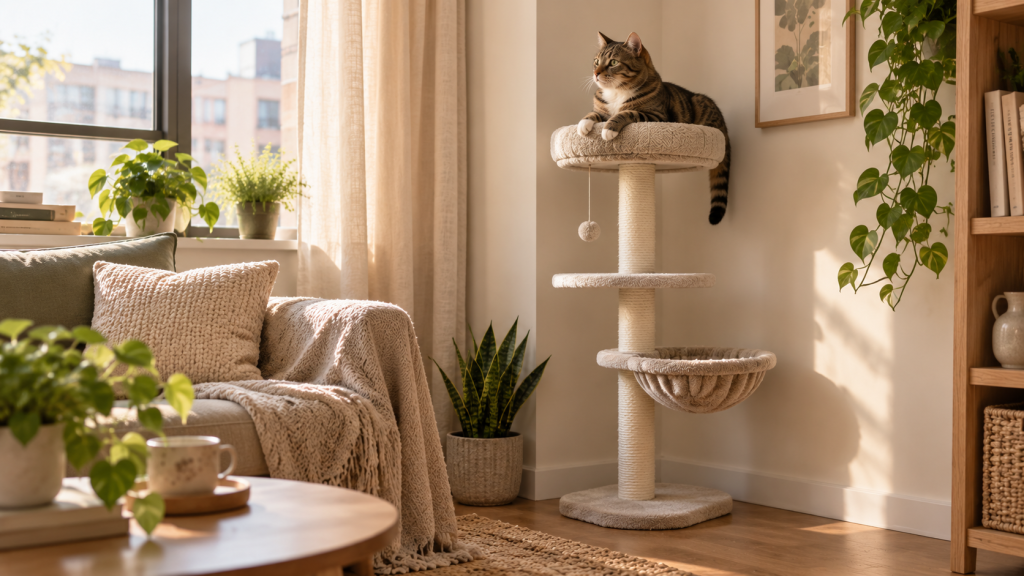
Most cat trees are designed for houses with a corner to spare. In a small apartment, a standard cat tree can eat up more floor space than your actual seating area — which is exactly why “compact” versions exist, and why not all of them are created equal.
This guide is about the specific tradeoffs of going smaller, and how to avoid ending up with a tree that’s compact but barely gets used.
The Core Tradeoff: Footprint vs. Function
A smaller footprint usually means one or more of the following: fewer platforms, a shorter overall height, a narrower base, or less scratching surface. None of these are automatically dealbreakers — but you want to choose which tradeoff you’re making on purpose, rather than by accident.
For a small apartment, the general priority order that tends to work well:
- Stability first. A narrow-footprint tree needs a genuinely solid base — this matters more, not less, as the footprint shrinks, since there’s less base weight to prevent tipping.
- Height over width. Going taller instead of wider gives your cat more usable space per square foot of floor it occupies — this is the entire logic behind compact trees that work well.
- Fewer, better platforms over many small ones. Two or three platforms your cat actually wants to sit on beat five cramped ones nobody uses.
What to Check Before Buying
Base footprint (not overall tree size). The number that matters for your floor space is the base dimensions, not the tree’s height or the size of the box it ships in. Measure your intended spot in inches before shopping.
Stability rating / tip-over resistance. Reviews are more useful than spec sheets here — look specifically for mentions of wobbling or tipping, especially from owners of larger cats.
Weight capacity per platform, not just for the tree overall — a top perch rated for less than your cat’s weight is a real safety issue, not just a comfort one.
Scratching surface material. Sisal rope or sisal fabric holds up far better than carpet for actual scratching behavior — if redirecting scratching from furniture is part of why you’re buying a tree, prioritize sisal-covered posts.
Wall-anchoring option. Some compact trees include an optional wall strap for extra stability — worth using even if not strictly required, especially with an active or larger cat.
Compact Cat Tree Styles That Work Well in Small Apartments
Tall, narrow multi-level trees. The classic “goes up instead of out” design — usually the best pure floor-space-per-function ratio, provided the base is stable.
Corner trees. Built with an angled back to fit directly into a room corner, reclaiming a spot that’s otherwise hard to use for anything else.
Tree + scratcher combo units. Smaller units that combine a short tree with a scratching post base — a reasonable option if you mainly want scratching redirection with just a little bit of height, rather than a full climbing structure.
Window-perch trees. A short tree positioned specifically to end at window height — trades overall height for a “destination” your cat will actually use daily. Pairs well with our wall-mounted shelf guide if you want to extend the route further without a taller tree.
When a Tree Isn’t the Right Call
If your apartment genuinely can’t spare any floor footprint at all, wall-mounted shelves (see our full guide) may serve your cat better than even the smallest compact tree, since they use zero floor space. Many small-apartment setups actually combine both: one compact tree as an anchor point, with wall shelves extending the route upward from there — see our guide to vertical cat furniture systems for how to plan that combination.
Frequently Asked Questions
How much floor space does a “compact” cat tree actually need? Compact trees generally have base footprints in the 16-24 inch range per side, versus 30+ inches for standard trees — but this varies enough by product that it’s worth checking the specific base dimensions rather than assuming “compact” means a fixed size.
Are compact cat trees less stable than full-size ones? Not necessarily, but a narrower base has less margin for error — stability depends more on build quality and design (like a wall-anchor option) than on size alone.
Will one small cat tree be enough, or do I need wall shelves too? For a single cat in a smaller apartment, a good compact tree alone is often enough. Multi-cat households, or cats with high energy/climbing drive, tend to benefit from adding wall shelves to extend the available vertical space.
Do compact cat trees work for large cat breeds? They can, but weight capacity and base stability matter more — check platform weight ratings carefully and lean toward trees with a wider (even if still “compact”) base if you have a larger cat.
Want the full picture on combining trees, shelves, and perches? See our Vertical Cat Furniture Ideas for Small Apartments guide.
1 comment