
This post contains affiliate links. As an Amazon Associate we earn from qualifying purchases, at no extra cost to you.
In a house, a litter box can live in a spare bathroom or basement and nobody thinks about it twice. In a studio or one-bedroom apartment, it’s often sitting a few feet from your bed, your kitchen, or your couch — which means both the box’s footprint and how well it contains odor and litter tracking matter a lot more than they would elsewhere.
This guide focuses specifically on what changes when space is the limiting factor, not just “best litter boxes” in general.
What Actually Matters in a Small Space (That Doesn’t Matter as Much Elsewhere)
Footprint, not just box size. A box that’s compact front-to-back can still be too deep to fit where you need it. Measure your actual spot — under a console table, in a closet, beside the toilet — before shopping, not after.
Litter tracking and scatter. In a bigger home, tracked litter spreads out and gets less noticeable. In a small apartment, it concentrates in the one or two rooms you actually live in. A box with a top-entry design or a taller lip does more work here than it would in a spacious house.
Odor containment. Ventilation dilutes smell in a large space. In a studio, there’s nowhere for it to go. Covered boxes with carbon filters, or well-designed top-entry boxes, matter more here than raw box size.
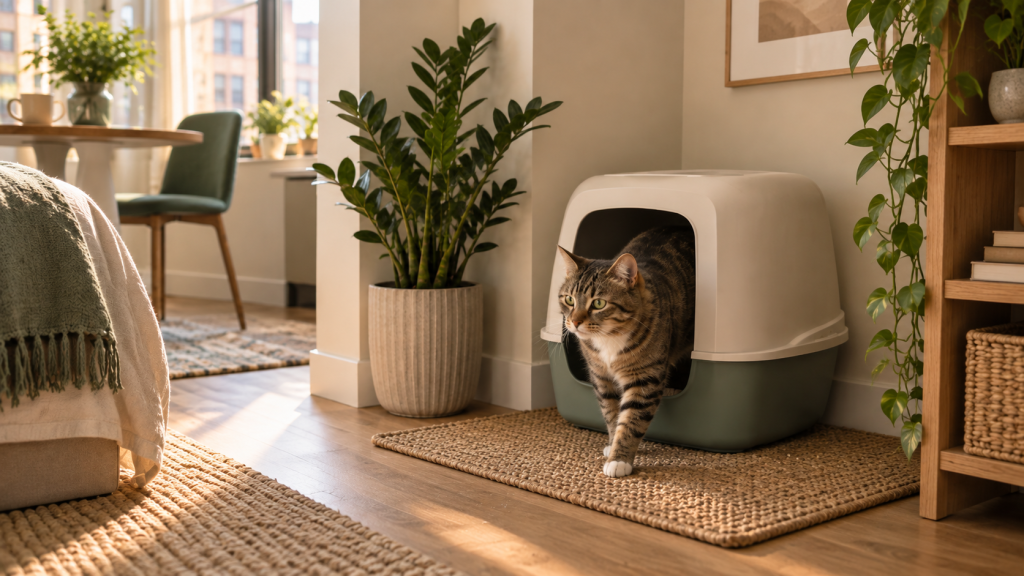
Visual footprint. In an open-plan studio, a bare box in the open is hard to avoid seeing (and having guests see). Enclosed designs, or ones built to tuck into furniture, solve a problem that simply doesn’t come up in a house with a spare room to dedicate.
Space-Saving Litter Box Styles
Corner-fit boxes. Triangular or angled boxes designed to tuck into a corner instead of sitting flush against a wall — this alone can reclaim a surprising amount of usable floor space in a small bathroom or closet.
Top-entry boxes. Cats enter from the top rather than the side. These tend to control both scatter and smell well, and have a smaller side profile — useful if the box needs to sit somewhere visible. Not ideal for older cats or kittens who may struggle to jump in.
Enclosed/furniture-style boxes. Boxes built inside an end table, bench, or planter-style shell. These take up roughly the same floor footprint as an open box but disappear visually — worth it specifically for studios where the box would otherwise sit in the main living area.
Low-profile open boxes. The simplest option: a smaller, shallower open box. Not the best at odor or tracking control, but the smallest true footprint and lowest cost, and easiest for any cat (including older or larger cats) to use without difficulty.
What to Check Before You Buy
- Interior floor space, not exterior dimensions. Manufacturers often lead with outer measurements — check the usable interior space against your cat’s size, especially for enclosed and top-entry designs.
- Entry height, if you have an older cat, a kitten, or a larger breed — top-entry designs in particular vary a lot here.
- Filter/liner costs over time. Enclosed boxes with carbon filters have an ongoing cost most people don’t factor in upfront.
- Ease of cleaning. A design that looks great but is awkward to scoop daily tends to get used less consistently — by you, not the cat.
A Note on Number of Boxes
The standard guidance from vets is one litter box per cat, plus one extra. In a small apartment that can feel impossible to fit, but it’s worth knowing this is a real factor in litter box avoidance issues (a cat that starts going elsewhere in the apartment). If full-size boxes don’t fit, this is exactly where a second smaller corner or low-profile box in a different spot can solve a problem a single larger box can’t.
For placement ideas that don’t eat into your living space, see our guide to where to put a litter box in a studio apartment.
Frequently Asked Questions
Are top-entry litter boxes bad for cats? Not inherently, but they’re a worse fit for older cats, kittens, or cats with mobility issues, since they require a jump to enter. Fine for most healthy adult cats.
Do covered litter boxes actually reduce odor, or is that a myth? A well-ventilated covered box with a carbon filter genuinely helps contain smell — but an uncovered box that’s scooped daily can outperform a covered box that isn’t. Design helps; cleaning frequency matters more.
What’s the smallest litter box that’s still comfortable for an average cat? As a rough guide, interior space of at least 1.5x your cat’s body length (nose to base of tail) lets them turn around and dig comfortably. Going smaller than that tends to cause avoidance issues regardless of how compact it looks.
Can I use one litter box for two cats in a small apartment? You can, but it increases the odds of one cat guarding or avoiding the box. If you’re seeing any litter box issues with two cats sharing, a second smaller box in a different location is the standard fix.
Next up: Where to Put a Litter Box in a Studio Apartment: 7 Smart Ideas — placement solutions for apartments with no spare room to hide it in.
1 comment