
This post contains affiliate links. As an Amazon Associate we earn from qualifying purchases, at no extra cost to you.
An outdoor cat gets a rotating supply of stimulation for free — new smells, moving prey, changing terrain. An apartment cat, especially one that’s indoor-only, gets whatever you actively provide. That gap is a real, well-documented driver of the boredom-related issues apartment cat owners run into most: overeating, destructive scratching, excessive vocalizing, or that 2 a.m. sprint around the apartment.
Enrichment toys don’t need floor space to work — which makes them one of the highest-value, lowest-footprint upgrades you can make in a small apartment.
Why This Matters More for Apartment Cats Specifically
The core issue isn’t “boredom” in a vague sense — it’s that hunting behavior (stalk, chase, pounce, catch) is instinctive and largely unmet by a bowl of food that shows up twice a day. Outdoor and yard-access cats work some of this instinct out on their own. Indoor apartment cats need it built into their environment on purpose.
This is also why some enrichment options work better than others: toys that let a cat work for a result (a puzzle feeder, an interactive wand toy) tend to outperform toys that are just there to be batted around once and ignored.
Categories That Actually Make a Difference
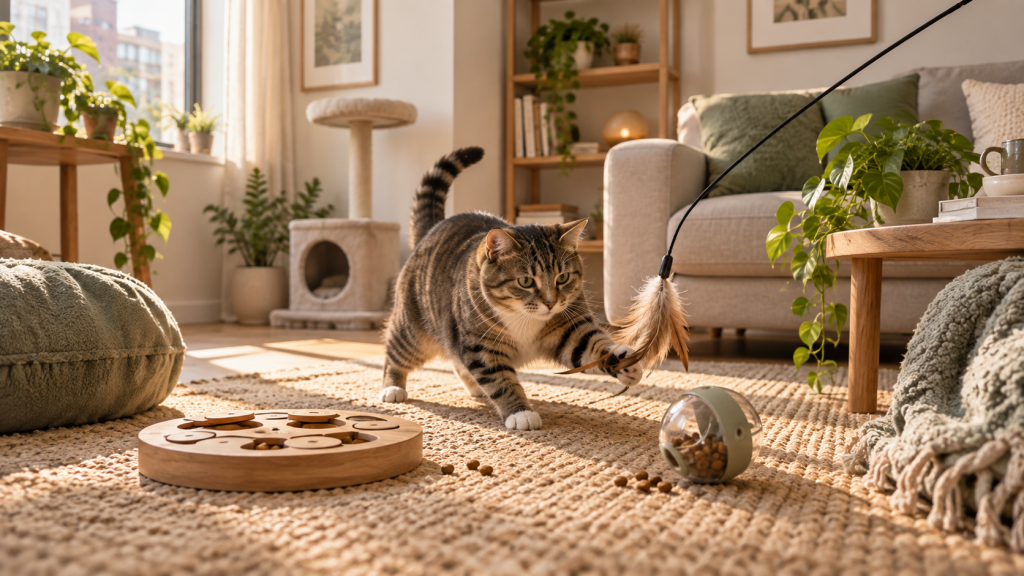
1. Puzzle feeders. Turn mealtime into an activity rather than a two-minute event. Especially useful for cats who eat too fast, or apartment cats showing signs of boredom-eating. Look for adjustable difficulty levels so you can start easy and increase the challenge over time.
2. Interactive wand toys. The closest thing to real hunting behavior you can offer indoors — a wand toy played for even 10-15 minutes a day covers a meaningful amount of an apartment cat’s stimulation needs. This is genuinely one of the best value-for-space enrichment purchases, since it requires zero permanent floor space at all.
3. Motion-activated / automatic toys. Useful for the hours you’re not home, especially for cats left alone for a full workday. Not a replacement for interactive play, but a real supplement — look for ones with an auto-shutoff and unpredictable movement patterns, since a fully predictable toy loses a cat’s interest quickly.
4. Window perches with a view. Not a “toy” exactly, but genuinely one of the highest-value low-footprint enrichment additions for an apartment cat — birds, people, and movement outside a window provide passive stimulation for free, all day. Pairs directly with our wall-mounted shelf guide if you’re building a route toward a window anyway.
5. Scratching-focused enrichment. Scratching is a normal behavioral need, not just claw maintenance — a dedicated sisal scratcher or post redirects an instinct that otherwise lands on your furniture. See below for what to look for.
6. Catnip and silvervine toys. A genuinely low-cost way to periodically refresh interest in existing toys — rotating in catnip- or silvervine-treated toys every week or two keeps a small toy collection feeling new.
What to Look for in a Scratching Post (Since It’s Enrichment Too)
- Sisal rope or sisal fabric, not carpet — carpet dulls faster and gives less satisfying resistance, which means cats often go back to furniture instead.
- Tall enough for a full stretch — a cat should be able to extend fully upright without reaching the top, roughly 28-32 inches for most adult cats.
- A stable, wide base — a wobbly post gets avoided regardless of material quality.
Rotation Matters More Than Quantity
A common mistake is buying a pile of toys and leaving them all out permanently — cats habituate to toys that are always available, the same way a room stops smelling like anything after a while. Keeping 2-3 toys out and rotating in “new” ones from a small stored collection every week or two keeps engagement meaningfully higher than a bigger toy pile left out all at once.
Building an Enrichment Routine (Not Just Buying Toys)
The toys matter less than the pattern of use. A rough baseline that works for most apartment cats:
- 10-15 minutes of interactive wand play, once or twice daily, ideally before meals (mimics a natural hunt-then-eat cycle)
- A puzzle feeder for at least one meal a day, rather than free-feeding from a bowl
- Passive options available all day — a window perch, a scratching post, a rotated toy or two
- Something for alone-time hours — an automatic toy or a food puzzle that doesn’t require your involvement
Frequently Asked Questions
How much daily playtime does an indoor apartment cat actually need? Most cats do well with 20-30 minutes of active interactive play per day, split into two sessions — this varies by age and individual energy level, but is a reasonable baseline to start from.
Are puzzle feeders worth it if my cat just eats normally? Yes, even for cats without weight or behavior issues — the mental engagement of “working” for food has value on its own, separate from any eating-speed benefit.
My cat ignores every new toy after a day or two. What am I doing wrong? This is usually a rotation issue, not a toy-quality issue — try storing most toys out of sight and swapping which ones are available every week or two, rather than leaving everything out permanently.
Do automatic toys replace the need for interactive play with me? No — they’re a good supplement for alone-time hours, but they don’t fully substitute for the responsive, unpredictable movement of a wand toy played by a person.
Building a full enrichment setup? Pair this with our Vertical Cat Furniture Ideas for Small Apartments guide — climbing space and play enrichment address different needs, and work best together.