
This post contains affiliate links. As an Amazon Associate we earn from qualifying purchases, at no extra cost to you.
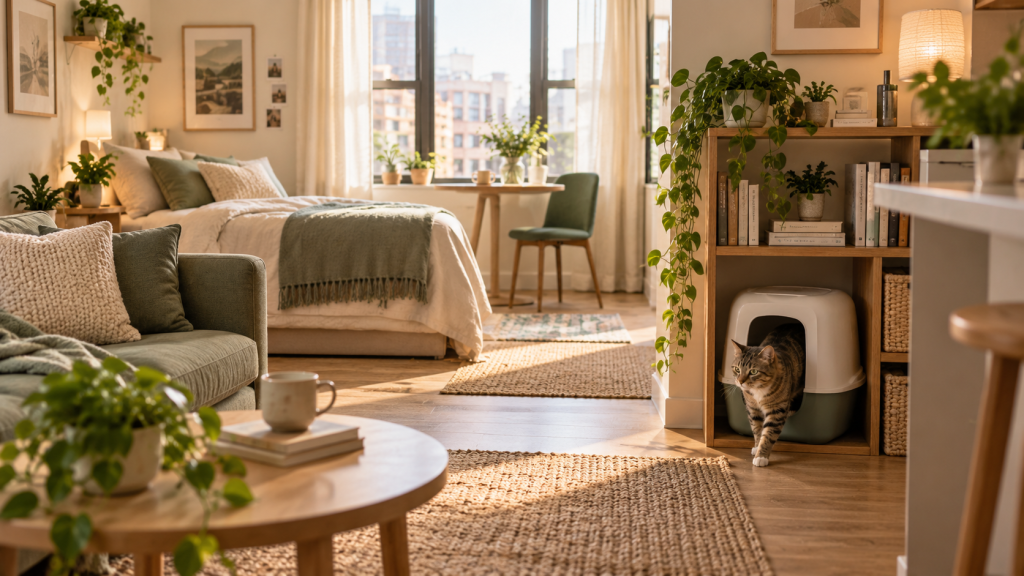
Most litter box advice assumes you have a spare bathroom, a basement, or a mudroom to tuck it into. In a studio apartment, none of that exists — there’s the room you live in, the bathroom, and maybe a closet. This is a placement guide for that actual situation, not the idealized house version.
What to Prioritize When You Don’t Have a “Spare” Room
Before the specific spots, two things matter more than looks:
Accessibility over concealment. A perfectly hidden box your cat has to work to reach gets used less, which leads to accidents elsewhere. Prioritize a spot your cat can get to easily and privately, even if it’s not fully out of sight.
Distance from food and water. Cats generally avoid eliminating near where they eat — keep the box a reasonable distance from feeding areas even when space is tight, or you risk both litter box avoidance and reduced eating.
With that in mind, here are 7 realistic placement options.
1. Bathroom Corner (With a Corner-Fit Box)
The most common solution, and for good reason — bathrooms already have flooring that handles moisture and litter tracking well, and a corner-fit box (see our compact litter box guide) can tuck in without blocking the door or shower.
2. Inside a Closet, With the Door Modified
Cut or prop the closet door for airflow and a permanent gap for entry (a cat door insert works well here), and use the closet floor space for the box. This hides the box almost entirely while keeping it fully accessible. Works best with a closet that isn’t in daily heavy use for clothes/storage.
3. Under a Console Table or Low Shelf
An enclosed, furniture-style litter box (built to look like an end table or bench) can sit in the open — beside a couch, under a window — without reading as “litter box” to anyone visiting. This is specifically the use case that furniture-style boxes exist for.
4. Behind a Room Divider or Folding Screen
If your studio is open-plan, a slim folding screen creates a visual (and slight physical) separation without needing an actual separate room. This works well combined with a low-profile open box, keeping the footprint minimal while still giving your cat a sense of privacy.
5. In the Entryway, Behind the Door’s Swing
Often-overlooked dead space: the area behind a door when it’s open, or a slim strip beside an entryway. A low-profile box can fit here in apartments where every other wall is already in use.
6. On a Balcony or Enclosed Porch (Climate Permitting)
If you have a balcony, a covered or enclosed box placed there keeps litter and odor completely out of your living space. Only works in moderate climates and requires checking your cat is comfortable with the door being open for access, or installing a pet door.
7. Under the Bathroom Sink (For Pedestal-Free Sinks)
If your bathroom sink has open space underneath rather than a full vanity cabinet, this is often unused real estate perfectly sized for a low-profile or corner box, especially in a bathroom too small for a corner placement elsewhere.
What to Avoid, Regardless of Space Constraints
- Right next to the food/water bowls — even if it’s the only open spot, cats reliably dislike this combination.
- A high-traffic path — if you walk directly past or over the box constantly, most cats will feel too exposed to use it consistently.
- Fully sealed-off spots with no airflow — a closet or cabinet with no ventilation concentrates odor rather than containing it.
A Quick Note on Multi-Box Households
If you’re keeping two boxes in a one-cat-per-box-plus-one setup (see our full litter box buying guide for why that’s recommended), you don’t need two identical setups in a small apartment — a full-size box in one primary spot, plus a small low-profile box in a secondary location (options 5 or 7 above), often solves the space problem better than trying to fit two full boxes side by side.
Frequently Asked Questions
Is it bad to keep a litter box in the bedroom? Not inherently, if it’s placed away from where you sleep and cleaned regularly — many studio apartment residents don’t have another option. Odor control (see our litter box guide) matters more in this placement than most others.
How far does a litter box need to be from food bowls? There’s no exact rule, but even a few feet of separation, or a visual barrier between the two, makes a meaningful difference to most cats.
Can I move a litter box’s location once my cat is used to it? Yes, but do it gradually if possible — move it a few feet at a time over several days rather than relocating it across the apartment in one step, to avoid confusing your cat into eliminating in the old spot.
Haven’t picked a box yet? See our Best Litter Boxes for Small Apartments guide for specific space-saving options by style and budget.
1 comment