
This post contains affiliate links. As an Amazon Associate we earn from qualifying purchases, at no extra cost to you.
If you’ve searched “vertical cat furniture” or “cat furniture for small apartments,” you’ve probably noticed most advice falls into one of two camps: general cat-behavior articles that don’t address apartment space constraints at all, or product roundups that assume you have room for a floor-to-ceiling cat tree in the corner of a spare room.
This is the version for an actual small apartment — how to think about the problem, and how the pieces (shelves, trees, perches) fit together instead of competing for the same wall.
Why “Vertical” Solves the Small-Apartment Problem Specifically
Floor space in a small apartment is finite and already spoken for — furniture, walking paths, storage. Wall space, by contrast, is almost always underused. A cat’s core need (elevated territory, a vantage point, a place to retreat to) doesn’t actually require floor space at all — it requires height, which is exactly what a small apartment still has plenty of.
This is the entire logic behind treating vertical furniture as a system rather than buying one product and hoping it’s enough.
The Three Building Blocks
1. A base — floor-level furniture that starts the route. This is either a compact cat tree (see our buying guide) or a piece of furniture your cat already uses (a couch arm, a low bookshelf). The base needs to be something your cat can reach without your help, since it’s the entry point to everything above it.
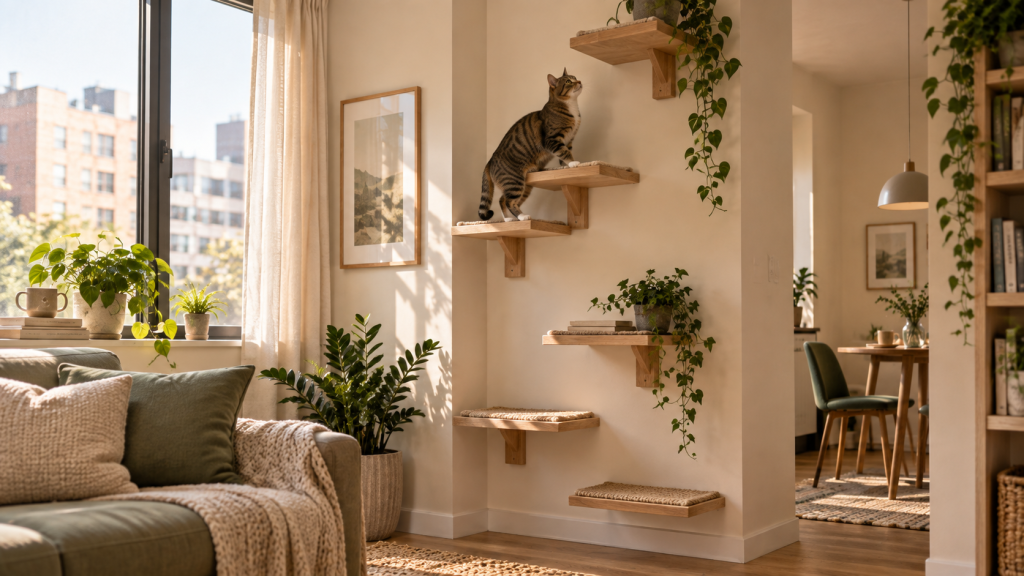
2. The route — wall-mounted shelves or steps. This is what actually reclaims floor space. A series of shelves (see our wall-mounted shelf guide and our step-by-step installation guide) extends the vertical territory upward from the base, using wall space that would otherwise sit empty.
3. A destination — a window perch or wide top shelf. Routes that end somewhere your cat actually wants to be (a window with a view, a wide enough shelf to nap on) get used consistently. Routes that just stop at a blank wall tend to get ignored after the novelty wears off.
How to Plan a System for Your Specific Apartment
Step 1: Identify your best wall. Ideally one with a window, near furniture your cat already climbs, without breakables directly underneath.
Step 2: Decide your base. A compact cat tree gives a sturdier, wider starting point than jumping straight from the floor to a wall shelf — worth the floor footprint if you can spare even a small corner.
Step 3: Plan 3-5 shelves as the route, spaced roughly 12-18 inches apart vertically. Full walkthrough in our installation step-by-step guide.
Step 4: End at a real destination — a window sill, a wide top shelf, or a dedicated perch — rather than treating the top shelf as an afterthought.
Budget and Space Priorities, by Apartment Type
Studio apartment, very limited floor space: Skip the tree, go straight to wall shelves starting low enough to reach from a couch or low furniture. Prioritize a route that ends at a window.
One-bedroom with a spare corner: A compact tree as the base (see our guide), extended with 2-3 wall shelves above it, gets you most of the benefit of a full vertical system without committing an entire wall.
Multi-cat apartments: Widen the route rather than just adding height — wider shelves, or two parallel lower-height routes, reduce one cat blocking access for another far better than a single tall, narrow path does.
Common Mistakes When Building a Vertical System
- Treating it as one product instead of a system. A single cat tree, or a single shelf, rarely gives the full benefit that a connected route does.
- Skipping the “destination.” A route that dead-ends at nothing gets used less over time, even if the climbing itself is well-designed.
- Underestimating weight capacity, especially on shelves near the top of a route, where a cat lands with more force than its static weight would suggest.
- Not testing gaps in person. A spacing that looks fine on a tape measure can still be an awkward jump for your actual cat — mark positions with painter’s tape before drilling.
Where to Start
If you’re building this from scratch, the most common (and most reliable) order is: pick your wall, choose a base (tree or existing furniture), then work through our wall shelf buying guide and installation guide to plan the route itself.
Frequently Asked Questions
Do I need a cat tree AND wall shelves, or is one enough? For a lot of apartments, one alone is enough — a good compact tree, or a well-planned shelf route on its own. Combining both gives the most territory per square foot of actual floor used, which is why it’s the setup we recommend if your budget and wall allow it.
How much does a full vertical cat furniture system cost? It varies widely by materials and how many pieces you’re combining, but a basic 3-shelf wall route plus a small compact tree is a reasonable, moderate-budget starting point — you can always extend it later once you see how much your cat actually uses it.
Will my cat actually use this, or is it a waste of money? Almost all cats use elevated territory when it’s placed thoughtfully (accessible entry point, sensible spacing, a real destination at the top). The setups that go unused are almost always missing one of those three things, not a sign the cat “doesn’t like height.”
Is this safe for kittens or senior cats? Yes, with adjustments — smaller gaps between steps and a lower starting height for both kittens (still building coordination) and senior cats (reduced jumping ability).
Start planning: Best Wall-Mounted Cat Shelves for Small Apartments · Best Compact Cat Trees for Small Spaces · How to Set Up a Cat Wall System, Step-by-Step
2 comments